Why the Monty Hall Problem Drives People Crazy
This essay isn’t to explain the solution to the Monty Hall problem—you can look that up anywhere—but to ask a related question: why does it seem to drive some people crazy? Why do they get so attached to their wrong answers, and so upset by the correct answer? That’s weird, right? People don’t usually care enough about math problems to get worked up over them, but there’s something about this particular problem that really pushes people’s buttons.
There is an answer to this question, and it’s not just “it’s a bit tricky and people don’t like being wrong.” It’s analogous to what Kahneman called attribution substitution, but instead of substituting an easier version of a question, people substitute an adversarial version of a game, so let’s call it “adversarial substitution.”
This is going to take some work to unpack, but I think it’ll be worth it because it explains a lot about how people understand (and misunderstand) the world around them.
The Monty Hall Problem
The Monty Hall Problem was best described on this episode of Brooklyn 99:
Prior to that, it was discussed by Marilyn vos Savant, to a famously negative public reaction. After giving the correct answer in a newspaper column, she was bombarded with hate mail vehemently insisting she was wrong. But why?
The glib answer is sexism, but this is at most only part of the reason. She wrote on many other topics which did not elicit the same reaction despite having the same author. No, there must be something about the problem itself that triggers an unusually strong reaction.
The Adversarial Variant
The original Monty Hall Problem assumes that Monty always shows you a goat and always gives you the option to switch. The sequence of play looks like this:
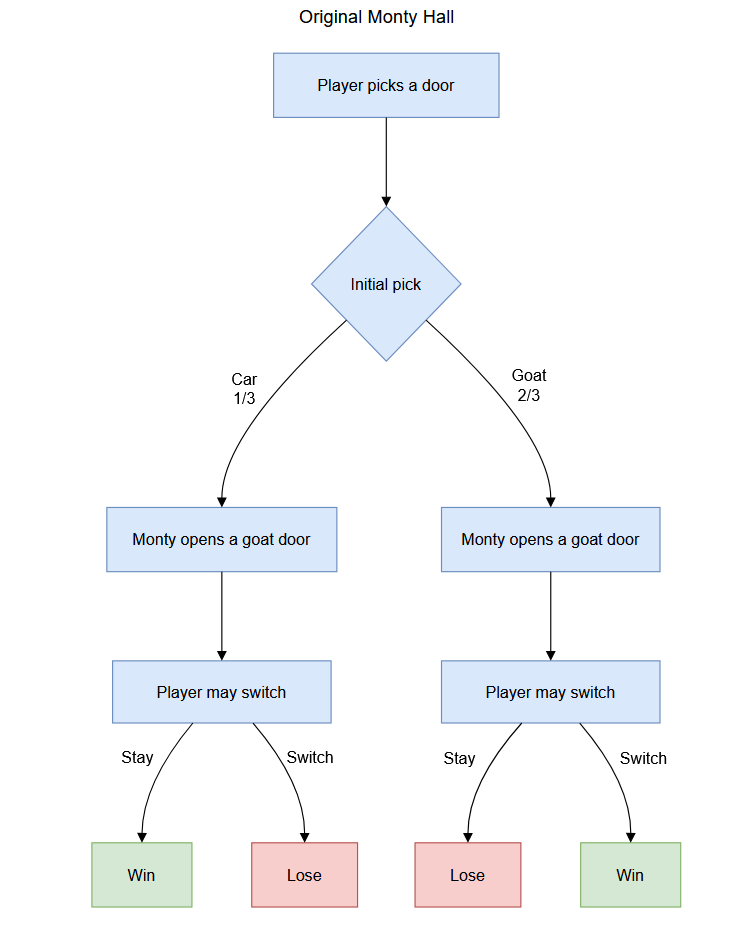
We’re now going to introduce an adversarial variation of the game. In this version, Monty has a choice: he can either open a door and give you the option to switch, just like in the original game, or he can immediately give you what’s behind the door you picked. He still has full information about what’s behind the door, of course. Let’s also say this is a zero-sum game: Monty doesn’t want you to win, and will make his choice based on whatever is worse for you.
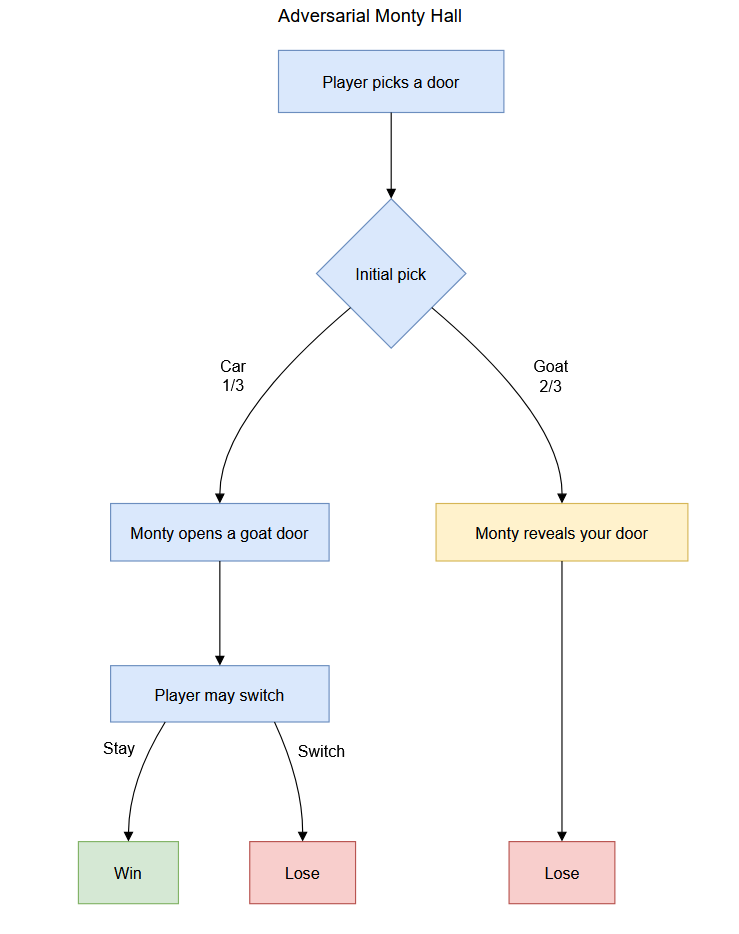
From Monty’s point of view, the optimal policy is obvious. He knows if the door you chose has a goat or a car behind it. If it’s a goat, he has zero incentive to offer you a chance to switch as that might result in you switching to the car. If it’s a car, then he has every reason to offer you the choice in the hope that you’ll switch.
That means from the player’s point of view, the game now looks like this:
It’s worth comparing the outcomes in these two different variants:
| Car Location | Original | Adversarial | ||
|---|---|---|---|---|
| Stay | Switch | Stay | Switch | |
| Initial Door | Win | Lose | Win | Lose |
| Other Door #1 | Lose | Win | Lose | Lose |
| Other Door #2 | Lose | Win | Lose | Lose |
The proportion of green in each column tells you the probability of winning under each strategy in each variant. In the original game, switching nets you a 2⁄3 chance of winning, vs. only 1⁄3 if you stay, so your best move is to switch. So much we already knew.
But look at outcomes for the adversarial game on the right. They’re completely different. Now if you switch, you really shoot yourself in the foot: there’s no chance of winning at all. That’s because Monty only gives you the opportunity to switch if he knows you’ve already chosen the car. It’s a trap: he’s giving you a second chance to make a mistake. Your only real option is to choose to stay if given a choice. Of course, you often won’t be given a choice: you’ll pick a goat door, he’ll immediately reveal it, and you’ll think, “ah, bad luck.” You never even know that you were denied an opportunity to switch unless you’d seen the game played before.
Card Forcing
This structure is reminiscent of the classic magician’s “force.” Suppose a magician wants you to end up with a particular card. He of course knows where it is, but he wants to make it seem as if you picked it. He asks you to cut the deck into two piles and point to one. If the force card is in the pile you indicate, he says, “great, we’ll use this one.” But if the force card is in the other pile, he reframes your gesture as eliminating the pile you pointed to: “fine, we’ll get rid of this one.” Either way, the pile containing the force card survives. From your perspective, it feels as though you made a free choice, but the magician was really using hidden information to reinterpret the meaning of your gesture to achieve his own ends.
Of course, if the magician kept doing that over and over, sometimes retaining the pile you select and sometimes eliminating it, you’d catch on pretty quickly. That’s why magicians use a wide variety of techniques to force cards and never use the same one twice.
What makes the force possible is that the rules weren’t fully explained up front. You’re just going along with the act, getting fed instructions one at a time, so there’s no way for you to see how the rules of the game are actually twisting themselves to ensure a certain outcome.
The Psychology
People are constantly on guard against being scammed. Even though Monty himself is playing fair, they still instinctively pick up on the fact that the whole setup is “scam-shaped.” Their intuition analyzes the adversarial variant instead of the original game and comes to the mistaken conclusion that they shouldn’t switch. They are instinctively suspicious of the fact that they’re getting an opportunity to second-guess themselves; why would Monty bother to do that if it didn’t benefit him in some way?
It’s worth reiterating that none of that adversarial stuff is in the actual rules of the game, which are explicit that Monty always reveals a goat and always gives you an opportunity to switch. So instead of being street smart, it’s just paranoid, and instead of protecting you, your lack of trust leads you astray.
I suspect that’s where the anger comes from: subconsciously people feel like switching is a trap that they should stay away from, but they can’t actually identify anything in the rules to justify that feeling. Of course not: the “catch” isn’t in the rules as stated, but in the space around those rules that an unscrupulous operator could take advantage of. All they’re left with is cognitive dissonance and the vague feeling they’re being taken advantage of somehow.
Precise Questions, Asked Imprecisely
There’s a long history of cognitive psychology researchers giving subjects highly abstract logic puzzles and clicking their tongues when subjects make the faux pas of interpreting their thinly veiled formulas as if they were normal English sentences. More often than not, it’s the translation into natural language that’s problematic, not the subjects’ ability to reason; when the same logic puzzles are rewritten in a more natural way, the supposed deficit in logical thinking disappears entirely.
A classic example is the Wason selection task. Subjects are shown four cards and told a rule like, “If a card has an even number on one side, then it has a red color on the other.” Their job is to decide on the absolute minimum number of cards that need to be turned over to confirm the rule.
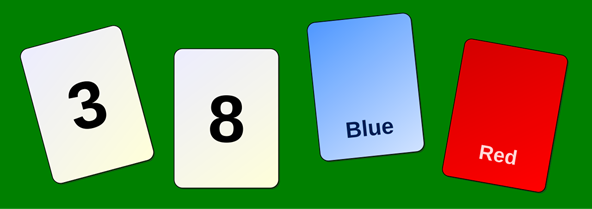
Most people perform badly on the abstract version of this task. But when the exact same logical structure is reframed as a social rule—“If a person is drinking beer, then they must be at least 21”—performance improves dramatically. People immediately understand that you need to check the beer drinker and the underage person.
Communicating badly and then acting smug when you’re misunderstood is not cleverness.
—Randall Munroe
The point is that translating between natural language and formal mathematics isn’t easy. For the Monty Hall problem, simply framing of the probability problem as a game show with money on the line that naturally causes people to start thinking of it in adversarial terms.
Conclusion
Is adversarial substitution actually a fallacy? Or is it a street-smart, robust strategy to avoid being conned? One thing we can say for sure is that doing it subconsciously is always a mistake.
The cardinal sin is to make a choice without knowing you are making one.
—Jonathan Shewchuk
However, merely being aware of the phenomenon lets us make a more intentional, conscious decision. When you start to get that gut feeling that you might be about to be scammed, ask yourself if you really have sufficient guarantees about the rules of the game to analyze it correctly. In the case of the Monty Hall problem, we can double-check the rules to confirm that Monty will always open a door and always reveal a goat. Once we are sure of that, we can follow the optimal strategy of switching doors. The net gain is an additional 1⁄3 of a car, doubling our expected reward.
On the other hand, in situations with different social dynamics, say playing a version of the same game against a street hustler, you might be wise to adopt the more defensive strategy of not switching.
It also pays to be aware that other people might be automatically making the same adversarial substitution. Maybe the reason they aren’t accepting a perfectly legitimate offer is because the structure of the deal feels like it could be exploited in some way, setting off alarm bells.
There needs to be a lot of trust, transparency, and clarity before we can take advantage of the opportunities in front of us, otherwise we’re liable to lose out while trying to play it overly safe.